
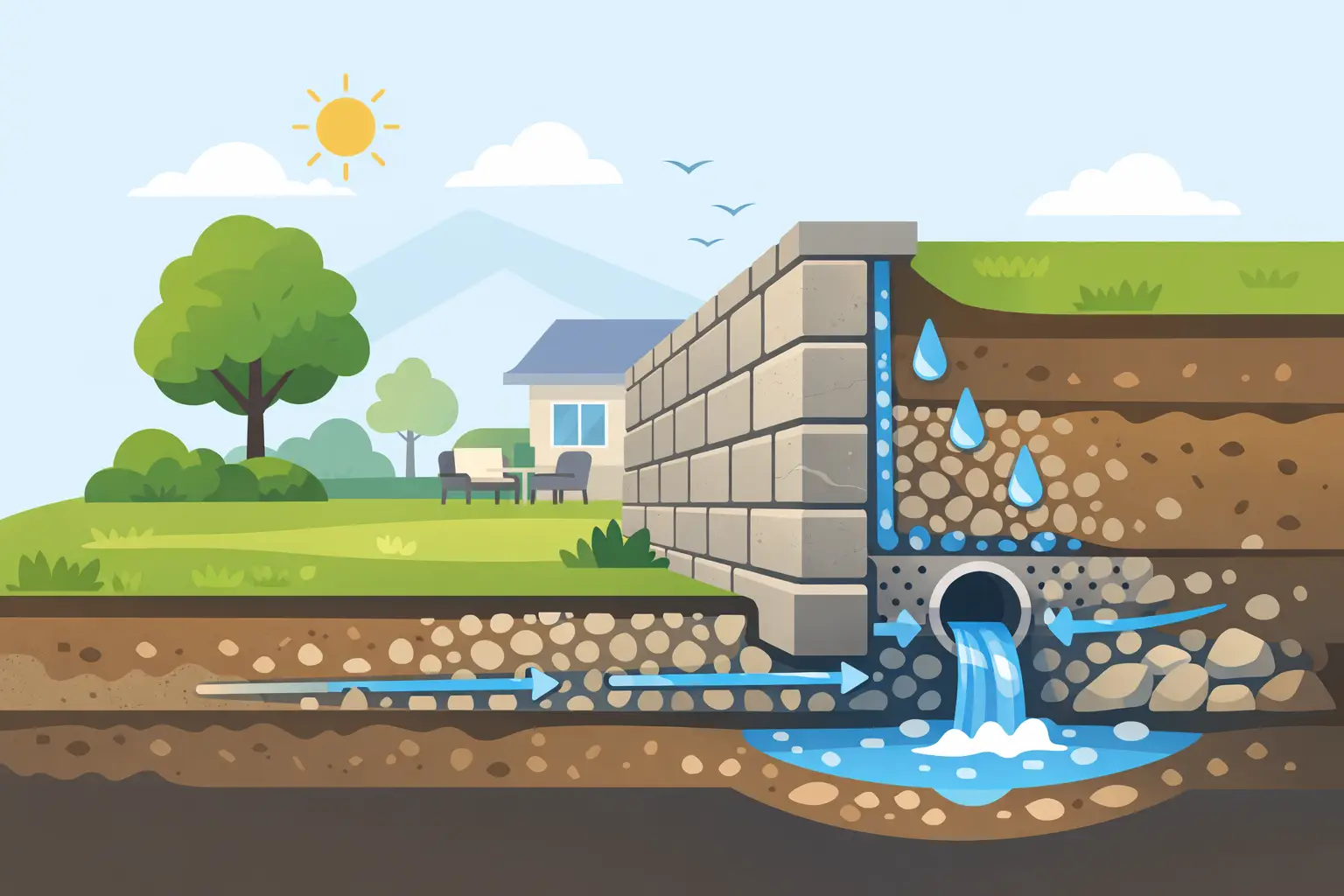
Water is what usually ruins a retaining wall – not age, not looks, and not the block itself. If you are planning a new wall or replacing a failing one, this retaining wall drainage guide will help you understand what keeps a wall standing, what causes pressure to build behind it, and why proper drainage matters just as much as the wall materials you choose.
Why drainage matters more than most homeowners expect
A retaining wall is built to hold back soil, but it is almost always dealing with water too. After a heavy Maryland rain, wet soil becomes heavier and pushes harder against the wall. If that water has nowhere to go, pressure builds behind the structure. Over time, that pressure can cause leaning, bowing, cracking, shifting, or complete failure.
That is why drainage is not an extra feature. It is part of the wall system. A beautiful wall with poor drainage can start showing problems surprisingly fast, while a properly built wall with the right drainage detail is far more likely to perform for years.
For homeowners, the real issue is cost. Fixing a failed retaining wall is usually far more expensive than building it correctly the first time. It can also affect nearby patios, walkways, fences, landscaping, and even the way water moves toward your home.
Retaining wall drainage guide: what a wall needs to work
A good retaining wall does not rely on blocks or timbers alone. It depends on a system that manages water before pressure has a chance to build. In most residential projects, that system includes gravel backfill, a drain pipe, filter fabric, and thoughtful grading.
Gravel backfill creates open space where water can move instead of getting trapped in dense soil. A perforated drain pipe at the base of the wall helps collect that water and direct it away. Filter fabric keeps surrounding soil from washing into the gravel and clogging the system. The grading above and around the wall helps surface water move away rather than pouring directly behind it.
If one part of that system is missing, the whole wall becomes more vulnerable. That does not mean every retaining wall is built exactly the same. Height, soil conditions, slope, wall material, and the amount of water on the site all influence the right solution.
The most common drainage components
Gravel backfill
This is one of the most important pieces of the system. Clean, angular gravel placed behind the wall allows water to pass through quickly. Native soil alone is not enough, especially if the site has a lot of clay. In many parts of Maryland and the DC area, clay-heavy soil holds water longer and increases hydrostatic pressure behind walls.
The width of the gravel zone depends on the wall design, but the principle is straightforward. Water needs a path to move down and out instead of sitting behind the structure.
Perforated drain pipe
A perforated pipe is usually installed near the base of the wall, surrounded by gravel. It collects water and moves it toward an outlet. Without an outlet, the pipe cannot do its job. That sounds obvious, but poor installations sometimes include drain pipe with no practical way for water to discharge.
The right pipe layout depends on the site. Some walls drain to daylight, while others may tie into a broader site drainage plan. This is one reason professional design and installation matter. The wall and the drainage system have to work together.
Filter fabric
Filter fabric separates soil from gravel. Its job is to let water pass while reducing the movement of fine soil particles into the drainage stone. Without it, the gravel can gradually clog and lose effectiveness.
This is one of those details homeowners may never see again after installation, but it has a direct impact on long-term performance.
Surface grading and water control
Even the best drain pipe cannot fully compensate for poor grading above the wall. If downspouts discharge near the wall, if a patio slopes toward it, or if runoff from a higher area concentrates behind it, the wall will be forced to manage more water than it should.
A well-built project looks at the entire area, not just the face of the wall. That may include adjusting grades, moving downspout discharge, or integrating the wall with nearby hardscape features.
Signs of drainage problems behind a retaining wall
Many drainage issues start quietly. Homeowners often notice cosmetic changes before they realize there is structural pressure building behind the wall.
A wall that leans forward, has bulging sections, develops stair-step cracks, or shows movement at the top deserves attention. You may also see soil washing out, wet spots near the base, staining on the face of the wall, or pooling water after storms. In timber walls, rot and accelerated deterioration can also point to long-term moisture problems.
Sometimes the wall itself is not the first clue. A sinking walkway, shifting patio edge, or recurring erosion near the wall can all signal that water is not being controlled properly.
Why some retaining walls fail early
The short answer is usually poor planning, poor installation, or both. Homeowners are often told a wall just needs stronger materials, but strength without drainage is not enough.
One common issue is backfilling with excavated soil instead of drainage stone. Another is skipping the drain pipe altogether on smaller walls because someone assumes it is unnecessary. Some projects fail because the wall was not designed for the slope, surcharge loads, or water conditions on the property. Others run into trouble because nearby improvements, such as fences, patios, or driveways, change how water moves across the site.
That is where experience matters. An established contractor looks at the property as a whole and builds with long-term performance in mind, not just fast installation.
New wall or replacement wall? The approach may differ
If you are building a new retaining wall, drainage should be addressed from day one. That is the easiest and most cost-effective time to get it right. The wall can be designed around the site conditions, with proper excavation, base preparation, backfill, and discharge planning.
If you are replacing a failing wall, the first step is figuring out why the old one failed. Sometimes the visible wall is only part of the problem. The site may have poor runoff control, clogged drainage stone, missing outlets, or grading that keeps forcing water toward the wall. Rebuilding without correcting those conditions can lead to the same issues again.
In some cases, a repair is possible. In others, replacement is the smarter investment. That depends on the age of the wall, the extent of movement, the surrounding structures, and whether the drainage system can be corrected without full reconstruction.
Choosing the right contractor for a drainage-focused wall
Retaining walls are not just stacking projects. They are structural landscape features that need proper planning, especially when drainage and grade changes are involved. For homeowners, that means choosing a contractor who understands both the wall itself and the way water behaves on your property.
Ask how the drainage system will be built, where water will discharge, and what materials will be used behind the wall. A trustworthy contractor should be able to explain the plan clearly, not brush past it. If the conversation is all about wall color and block style, with little attention paid to drainage, that is a red flag.
For many homeowners in Maryland and Washington, DC, it also helps to work with a company that handles broader exterior improvements. Retaining walls often interact with fences, patios, walkways, and yard grading. A coordinated design-build approach can reduce headaches and lead to a better finished result.
A retaining wall drainage guide should always come back to longevity
Homeowners usually start by thinking about appearance, and that makes sense. A retaining wall changes the look and function of your yard. But the hidden work behind the wall is what protects your investment.
The best retaining wall projects balance engineering, drainage, and curb appeal. They are built to handle rain, changing soil conditions, and years of pressure without putting your property at risk. At A-1 Fencing, that is the kind of craftsmanship homeowners expect when they invest in outdoor improvements that need to last.
If you are considering a retaining wall, ask the drainage questions early. A wall that looks great on day one should still be performing years later, long after the gravel, pipe, and grading details have disappeared from view.