
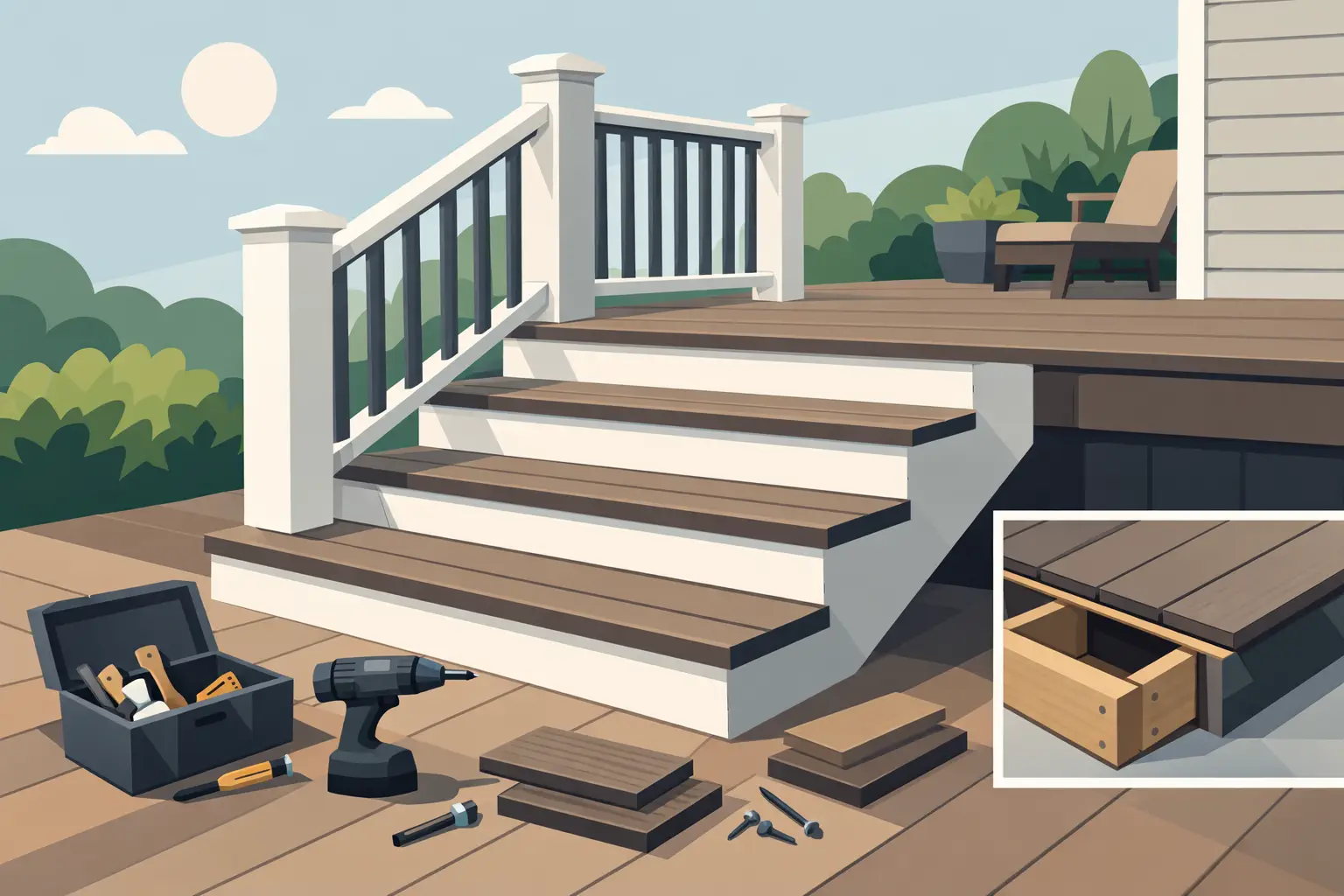
A deck can look finished from the top and still feel incomplete the moment you step off the edge. Stairs are where comfort, safety, and craftsmanship all meet, which is why homeowners asking how to build deck stairs with composite decking are usually trying to avoid one thing – a staircase that looks good for a season and becomes a problem later.
Composite stair construction is not just a standard wood stair with different treads. The framing, spacing, support, and finish details matter more because composite boards behave differently than pressure-treated lumber. They are durable, low maintenance, and attractive, but they also need proper support and careful installation to prevent sagging, movement, and premature wear.
How to build deck stairs with composite decking the right way
The first step is to start with the total rise from the deck surface to the landing below. That measurement determines the number of steps, the riser height, and the tread layout. In Maryland and DC-area projects, code compliance is not something to treat as a finishing detail. Stair geometry has to be consistent. Even small variations in riser height can create a tripping hazard and fail inspection.
Once the rise is measured, the stair run is calculated based on the required tread depth. Composite treads often require a little more planning than wood because the board width and manufacturer spacing requirements can affect the final layout. If you are using a picture-frame style border or fascia treatment, that needs to be included early, not added as an afterthought.
Stringers come next, and this is where many stair failures begin. Composite decking is not structural, so the strength of the stairs comes from the framing below. Stringers must be cut accurately and installed with enough support to handle the weight of the treads and foot traffic over time. Wider stairs usually need more stringers than homeowners expect because composite boards often require tighter on-center spacing than wood. That requirement depends on the brand and profile, which is one reason experienced installation matters.
Framing matters more than the composite boards
If the goal is a staircase that feels solid underfoot, the frame deserves most of the attention. Pressure-treated framing is typically used under composite stair treads, and it should be straight, properly fastened, and protected from standing water. Stair framing should connect securely to the deck structure, not just rest in place and hope for the best.
A proper landing at the base also matters. Some stairs terminate onto a concrete pad, some onto a patio, and some onto a compacted landing area. What works best depends on drainage, grade, and how the stairs connect to the rest of the backyard. If the base shifts, the entire staircase can begin to rack or pull apart. That is especially important in our region, where freeze-thaw cycles can expose weak construction quickly.
Blocking is another detail that makes a visible difference. Composite stair treads benefit from firm, even support. Without adequate blocking and spacing, the staircase can develop bounce, squeaks, or visual waviness. None of those problems improve with time.
Choosing the right composite stair materials
Not every composite deck board is meant to be installed on stairs in the same way. Some manufacturers offer dedicated stair tread options, matching fascia, riser boards, and fastening systems. Others have stricter span limits or specific guidance for stair nosing and edge detail.
That is why product selection should happen alongside stair design, not after the frame is already built. Trex and TimberTech, for example, offer quality composite options, but each product line has its own installation rules. Following those requirements protects both the appearance of the stairs and the material warranty.
Color and texture also matter more on stairs than on the deck surface. Stairs get concentrated foot traffic, and they are a focal point from the yard. A board that looks great across a broad deck may show seams or edge lines differently on narrow stair treads. The best result is usually one that balances appearance with practical performance.
The details that make composite deck stairs last
Drainage is one of the biggest long-term issues. Composite boards resist rot, but the framing underneath does not become maintenance-free just because the visible surface is composite. Water needs a path to move away from the stairs. That means proper gaps between boards, no trapped debris at the back of the tread, and a landing area that does not hold moisture against the structure.
Fastening matters too. Face-fastened stairs often provide the most secure installation, especially on high-traffic steps. Hidden fasteners can work in some deck field applications, but stair installations usually call for a stronger, more direct fastening method. The pattern should be clean, consistent, and installed according to manufacturer specifications.
Then there is nosing. Some composite stair systems use a defined nosing profile, while others rely on a flush tread design with careful board placement. The right approach depends on the product, local code requirements, and the overall design of the deck. There is no one-size-fits-all answer here, and that is exactly where good planning saves headaches later.
Railings, lighting, and safety features
A staircase is only as safe as its full system. Guardrails and handrails need to meet code, feel sturdy, and fit the design of the deck. For many homeowners, this is where the project shifts from basic access to a true outdoor living upgrade. A well-built stair with coordinated railing, lighting, and trim looks intentional and makes the whole deck feel more finished.
Low-voltage stair lighting is especially popular because it improves visibility without overwhelming the space. It also helps families and guests use the deck safely after dark. If the deck connects to a patio, walkway, or pool area, lighting becomes even more valuable.
Handrail placement can be straightforward on a simple run of stairs, but it gets more complex when landings, wide steps, or multiple directions are involved. The earlier these details are built into the design, the better the final result will be.
Common mistakes when building deck stairs with composite decking
The most common mistake is treating composite boards like wood and assuming standard framing rules will be enough. In many cases, they will not. Composite treads may need more stringers, closer spans, and more fastening support than a homeowner expects.
The second mistake is ignoring water. Even premium materials can underperform when the stairs trap moisture, collect debris, or sit on an unstable base. A staircase should shed water, not hold it.
The third is focusing only on the visible finish. Clean miters, matching colors, and nice fascia are great, but none of them matter if the rise is inconsistent or the structure feels soft underfoot. The best-looking stair is the one that still feels solid years later.
There is also the question of repairs versus replacement. If an existing deck staircase has framing issues, simply resurfacing it with composite is usually not the smart move. Sometimes the right answer is rebuilding the stairs properly so the investment in composite materials is actually protected.
Why many homeowners hire a deck contractor instead
For homeowners who are not looking for a DIY project, understanding how to build deck stairs with composite decking is still useful because it helps you ask better questions and evaluate the quality of a proposal. You want to know whether the contractor is planning around manufacturer specifications, local code, drainage conditions, and the way the stairs will be used every day.
This is also where design-build experience matters. Stairs are rarely isolated from the rest of the property. They connect the deck to a patio, yard, walkway, gate area, or retaining wall transition. When one contractor can handle the full exterior picture, the finished project tends to work better and look more cohesive.
At A-1 Fencing, we see that concern often from homeowners across Maryland and the DC metro area. They want a staircase that is attractive, durable, and built by a team that respects their property and gets the details right the first time.
Composite deck stairs are a smart investment when they are planned as part of the whole outdoor space, not rushed in as a final add-on. If you are considering new stairs or replacing unsafe ones, the best next step is to look beyond the boards and focus on the structure, drainage, and craftsmanship that will support every step for years to come.