
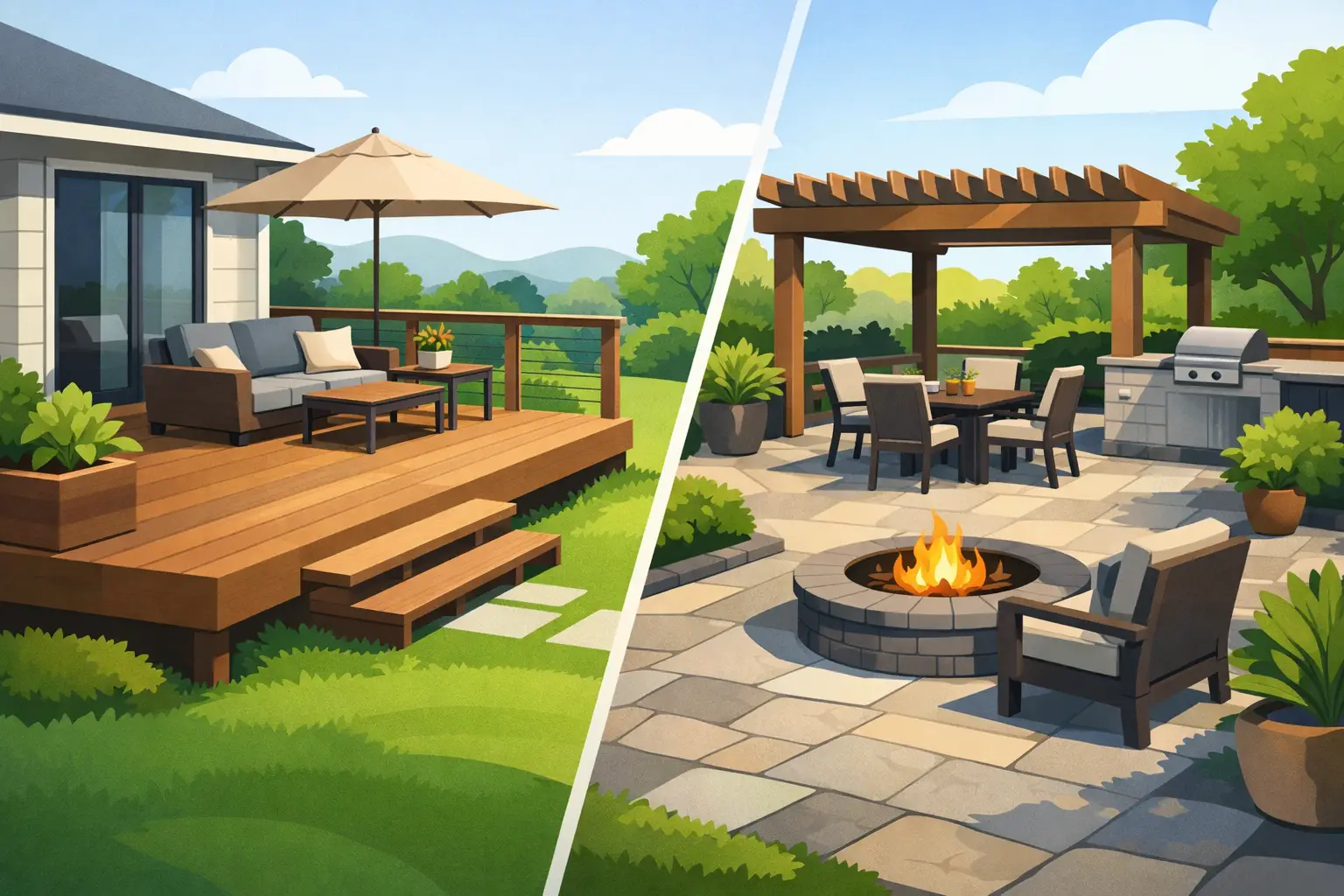
A backyard upgrade can change how your family uses the property this year – and how buyers see it years from now. When homeowners ask about deck vs patio value, they are usually weighing more than resale dollars. They want an outdoor space that fits the home, handles Mid-Atlantic weather, and feels worth the investment every time they step outside.
The better choice is not always the one with the lower installation price or the larger online return-on-investment estimate. A deck and a patio create different experiences, solve different site challenges, and appeal to buyers in different ways. The strongest project begins with a clear look at your yard, your goals, and the quality of the finished work.
Deck vs Patio Value: What Buyers Actually Notice
Prospective buyers rarely calculate the exact cost of a deck board or paver. They notice whether the outdoor area looks intentional, usable, well maintained, and connected to the home. A clean, professionally built deck or patio can make a backyard feel like an additional living area rather than unused space.
A deck often carries strong appeal when it extends directly from a kitchen, family room, or elevated rear door. It creates a natural place for grilling, dining, and entertaining at the same level as the home. For properties with a sloped yard, a deck can turn an otherwise difficult transition into a comfortable outdoor destination.
A patio has a different kind of value. It can make a yard feel grounded, permanent, and ready for gathering. Homeowners often choose patios for fire pits, outdoor fireplaces, dining areas, walkways, and seating walls. On a relatively level lot, a well-designed paver patio can create a polished outdoor living space with broad appeal to families and buyers who want low-step access to the yard.
Neither feature guarantees a dollar-for-dollar return at sale. Market conditions, neighborhood expectations, material quality, and overall home condition all matter. Still, both can improve perceived value by giving buyers a finished exterior they do not have to plan or pay for immediately after moving in.
Upfront Cost Depends on the Site and Materials
A patio is often less expensive than a deck of similar size when the yard is flat and accessible. It does not require footings, framing, railings, or stairs, and basic concrete can be a straightforward option. But patio pricing rises when the project needs excavation, grading, drainage work, a retaining wall, premium pavers, steps, or complex curves.
Decks typically require a higher initial investment because they are structural additions. Posts, beams, joists, footings, railings, stairs, and permits may all be part of the job. An elevated deck also requires careful engineering and installation to provide the safety and durability homeowners expect.
Material selection can shift the equation significantly. Pressure-treated wood may lower the initial cost, while composite decking from trusted brands such as Trex or TimberTech can cost more upfront but reduce routine maintenance over time. For patios, standard concrete, stamped concrete, and premium pavers each bring a different price point, appearance, and repair profile.
The least expensive quote is not necessarily the best value. Poor base preparation under a patio can lead to settling, drainage problems, and uneven pavers. Inadequate deck framing or improperly installed railings can create expensive repairs and safety concerns. Homeowners should compare scopes carefully, including site preparation, materials, drainage, permits, cleanup, and warranty coverage.
Long-Term Maintenance Changes the Value Conversation
Maintenance is where many homeowners begin to see the practical difference between a deck and a patio. A wood deck needs regular attention to preserve its appearance and protect it from moisture, sun exposure, and seasonal wear. Depending on the material and finish, that may include washing, staining, sealing, board replacement, and fastener checks.
Composite decking lowers the maintenance burden. It still benefits from periodic cleaning, but it does not need the same recurring staining and sealing schedule as natural wood. For busy families in Maryland and the Washington, DC metro area, that can be a meaningful advantage. A composite deck can keep a finished appearance with less weekend upkeep.
Paver patios are durable and relatively simple to maintain, but they are not maintenance-free. Leaves, dirt, moss, and weeds can collect in joints, while freeze-thaw cycles may eventually require minor leveling or joint-sand refreshes. High-quality installation matters because a properly prepared base and effective drainage help the surface stay stable through changing seasons.
Concrete patios can be easy to clean, though cracking is a common concern over time. Repairs may be more noticeable than a localized paver replacement. If long-term flexibility and repairability matter, pavers can be especially attractive.
Consider How Your Yard Works Today
The best return comes from building the space your property is asking for. A deck makes sense when the back door sits well above grade, when the yard slopes away from the house, or when you want an elevated view. It can also create usable square footage over a lower-level walkout or uneven terrain without extensive regrading.
A patio is often the natural choice for a home with a level backyard and easy access from a ground-level door. It works particularly well for homeowners who want a larger entertaining zone, a fire feature, or a smooth connection to a pool, garden, or lawn. Patios can also be designed in stages, with room to add a seating wall, outdoor kitchen area, walkway, or landscape lighting later.
Drainage deserves close attention in either project. Water should move away from the home, not collect against the foundation, under a deck, or across a patio surface. This is one reason a professional site evaluation is more valuable than choosing a design based only on photos online.
Lifestyle Value Is Real Value
Resale potential matters, but a project should also deliver value while you live in the home. A deck may be the better fit for someone who wants morning coffee off the kitchen, a private elevated lounge area, or direct access from the main floor. A patio may be better for families who want kids and guests moving easily between the house and yard, with room for a fire pit and multiple seating areas.
Think about furniture, traffic flow, shade, privacy, and the number of people you host. A compact deck with well-planned stairs may serve a small household better than an oversized patio. On the other hand, a generous patio with a retaining wall and built-in seating can make a sloped or underused yard feel completely transformed.
Quality Construction Protects Your Investment
Homeowners often compare deck vs patio value as if the decision ends with the material. In reality, craftsmanship has just as much influence on durability, appearance, and buyer confidence. Straight lines, solid railings, proper footing depth, clean paver edges, stable steps, and thoughtful drainage are visible signs of a project built to last.
A coordinated outdoor plan can add even more value. A new deck may look stronger with a matching privacy fence, gate, or walkway. A patio may become a true entertaining area when paired with a retaining wall, fireplace, or defined landscape border. Working with one experienced exterior contractor helps keep those elements cohesive rather than pieced together over several years.
A-1 Fencing provides free in-home consults and estimates for homeowners who want experienced guidance on decks, patios, hardscapes, and the exterior features that bring a property together. The goal is not to push one option for every yard. It is to recommend a well-built solution that fits the home, the budget, and the way your family plans to live outside.
Before choosing, stand at the back door and picture an ordinary Saturday, not just a future sale. The right deck or patio is the one that makes the yard easier to enjoy, easier to maintain, and more inviting from the first season onward.