
A beautiful patio can start failing long before a paver cracks or a retaining wall shifts. Water that lingers along the house, settles at the edge of the patio, or runs toward a neighbor’s property can create expensive problems beneath the surface. This patio drainage design guide explains what homeowners in Maryland and the Washington, DC area should consider before building, replacing, or expanding a patio.
Drainage is not an accessory added after the hardscape is complete. It is part of the design from the first site measurement. The right plan protects your home’s foundation, preserves the patio base, helps prevent erosion, and keeps your outdoor space usable after a heavy summer storm or a winter thaw.
Start With Where the Water Goes
Every patio needs a clear destination for water. The goal is not simply to move water off the paver or concrete surface. It is to direct runoff away from the house without creating a new problem at a property line, planting bed, walkway, or low area of the yard.
A contractor should first evaluate the existing grade, roof runoff, downspout locations, soil conditions, nearby retaining walls, and the natural low points of the property. This matters especially in established Maryland neighborhoods, where yards may have mature landscaping, older drainage patterns, and limited room between homes.
Patio surfaces generally need a gentle pitch away from the home. A common target is about 1/8 to 1/4 inch of fall per foot, though the appropriate slope depends on the material, patio size, site conditions, and local requirements. Too little slope allows water to pond. Too much slope can feel uncomfortable underfoot and may send water too quickly into the lawn or landscape beds.
The finished patio elevation also matters. It must work with door thresholds, siding clearances, existing walkways, and the surrounding grade. Raising a patio without accounting for those details can accidentally direct water toward the foundation or trap it against a wall.
Choose a Drainage Solution That Fits the Site
There is no one drainage system that works for every backyard. A level yard with well-draining soil calls for a different approach than a sloped property with compacted clay, roof runoff, and a retaining wall. The best designs often use more than one method.
Surface grading and swales
For many patios, careful grading is the first line of defense. The patio slopes away from the house, and the adjacent landscape is shaped to carry water toward a safe discharge area. A shallow swale can guide runoff across the yard without looking like a ditch.
This option can be effective and discreet, but it requires enough space and a suitable destination. It may not be enough on a tight urban or suburban lot where water has nowhere to spread naturally.
Channel drains near the house or patio edge
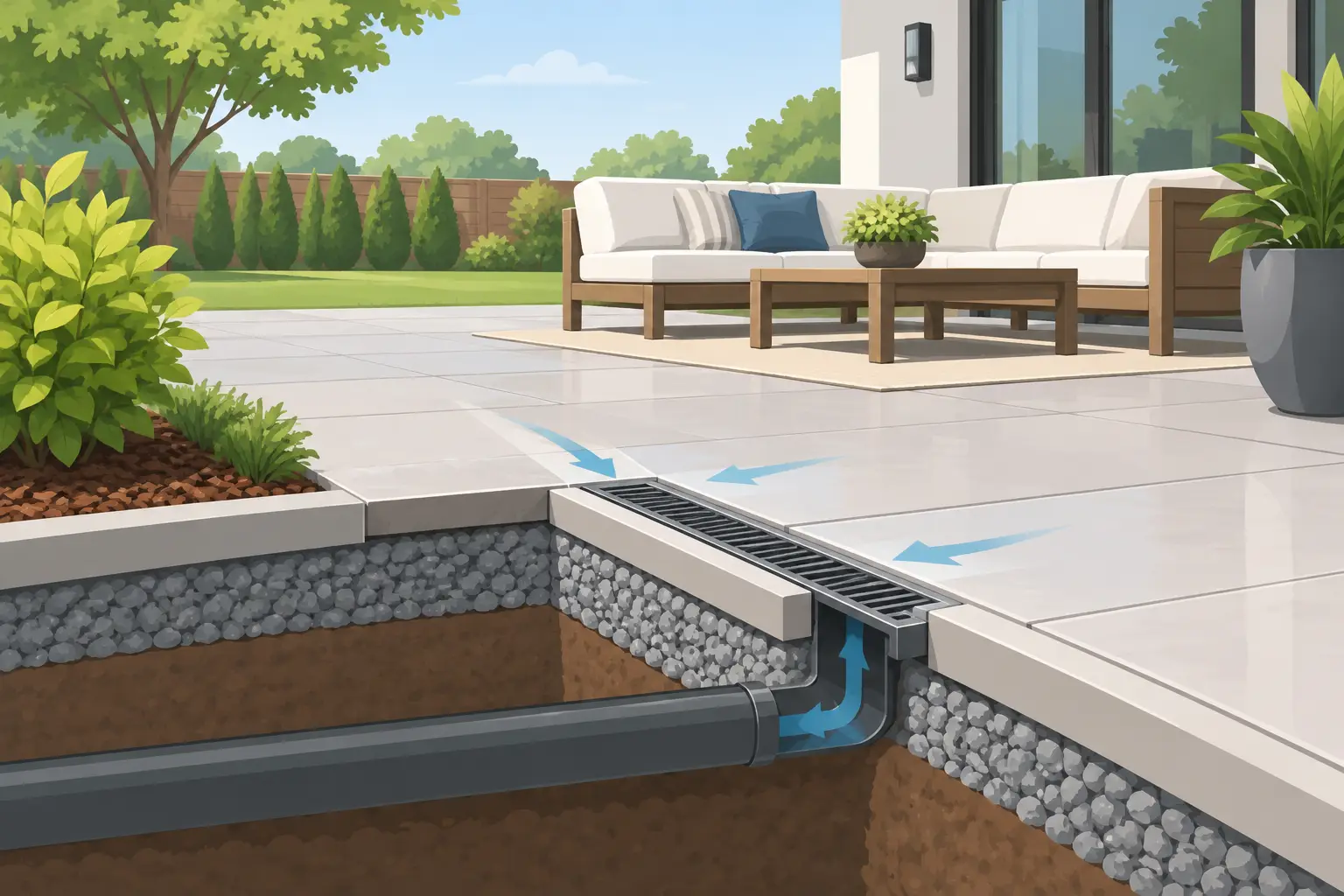
A linear channel drain is often useful where a patio meets a doorway, a foundation wall, a pool deck, or another area that cannot tolerate runoff. The drain captures surface water in a narrow grate and carries it through a pipe to an approved outlet.
Channel drains provide strong protection in difficult locations, but they must be installed at the correct elevation and kept clear of leaves, mulch, and debris. A drain that is poorly pitched or has no practical outlet is not a solution. It is simply a hidden place for water to collect.
French drains and subsurface collection
A French drain uses gravel, perforated pipe, and filter fabric to collect water below the surface. It can help when groundwater, seepage behind a retaining wall, or water moving through the soil is causing trouble near a patio.
This is not a replacement for proper patio slope. Surface water should still shed away from the home. Instead, a French drain can support the larger system by relieving wet areas before they undermine the base or saturate nearby soil.
Permeable pavers
Permeable pavers allow water to move through the joints and into a specially designed aggregate base below. They can reduce surface runoff and create a cleaner appearance than visible drains in some settings.
Their performance depends on proper excavation, base construction, edge restraints, and maintenance. They are a strong choice where local conditions and soil infiltration allow, but they are not automatically the right answer for every yard. Heavy clay soils, high groundwater, or a poorly managed roof runoff system may require additional drainage measures.
Do Not Ignore Downspouts
Roof water is one of the most common reasons a patio stays wet. A single downspout can release a surprising amount of water beside the house during a storm. If that water empties onto a patio or directly into the gravel base, it can wash out joint sand, shift pavers, and increase pressure around the foundation.
Downspouts should be planned as part of the patio project, not treated as an afterthought. Depending on the site, they may need to be extended underground, redirected to a properly graded discharge area, or tied into an approved drainage system. The endpoint matters as much as the pipe. Sending water a few feet away from the house is not enough if it immediately flows back toward the patio.
A reliable contractor will also consider access for future maintenance. Buried lines should be located thoughtfully so repairs do not require tearing out finished hardscape later.
Build the Base for Water, Not Just Appearance
The visible surface gets the attention, but the aggregate base below a patio is where long-term performance is decided. A properly prepared base provides stability while allowing water to move as intended. If the base is too shallow, poorly compacted, or constructed with the wrong materials, the patio may settle even when the surface appears to have the correct slope.
For paver patios, excavation depth and base thickness depend on soil conditions, anticipated use, paver type, and the design of adjacent features. A patio supporting a dining set has different demands from a space that transitions to steps, a retaining wall, or an outdoor fireplace. In freeze-thaw conditions common across Maryland and DC, a stable, well-compacted base helps reduce movement during seasonal weather changes.
Edge restraints are equally important. They hold pavers in place as the patio expands and contracts naturally over time. Without them, joints can open, edges can spread, and water can find paths into areas that were not designed to carry it.
Coordinate Drainage With Retaining Walls and Walkways
A patio rarely stands alone. It may connect to a walkway, sit beside a fence, meet a deck, or rely on a retaining wall to create a usable level space. Each feature changes how water moves through the property.
Retaining walls need drainage behind them to relieve hydrostatic pressure. Without it, saturated soil can push against the wall, cause staining, or contribute to movement. The patio above or beside the wall must be graded so surface water does not constantly overload that drainage zone.
Walkways should also be pitched intentionally. A path that drains toward a patio can turn the patio into a collection point. When multiple hardscape features are designed together, grades and drain locations can be coordinated before construction begins. That usually produces a better-looking result and helps avoid costly rework later.
Watch for Warning Signs Before You Build
Homeowners often call after spotting a puddle, but drainage issues can show up in less obvious ways. Dark staining along the foundation, loose or washed-out joint sand, moss growth in one section of the patio, soggy lawn edges, and recurring mulch washout all point to water moving where it should not.
Cracked pavers or settling sections do not always mean the pavers themselves are defective. The cause may be below the surface: inadequate base material, soil movement, a broken drain line, or persistent runoff from a roof. Repairing only the visible area may provide a short-term improvement while the underlying water issue continues.
Make Drainage Part of the Design Conversation
A patio should feel like an extension of your home, not a surface you avoid after rain. That begins with a site-specific plan that balances appearance, drainage, access, and long-term durability. During a free in-home consult and estimate, A-1 Fencing can evaluate how a new patio, walkway, retaining wall, or outdoor living feature will work with the grade and drainage needs of your property.
The most dependable patio designs do not draw attention to their drainage systems. Water simply moves where it belongs, the surface stays comfortable and stable, and your family gets more days to enjoy the backyard you invested in.