
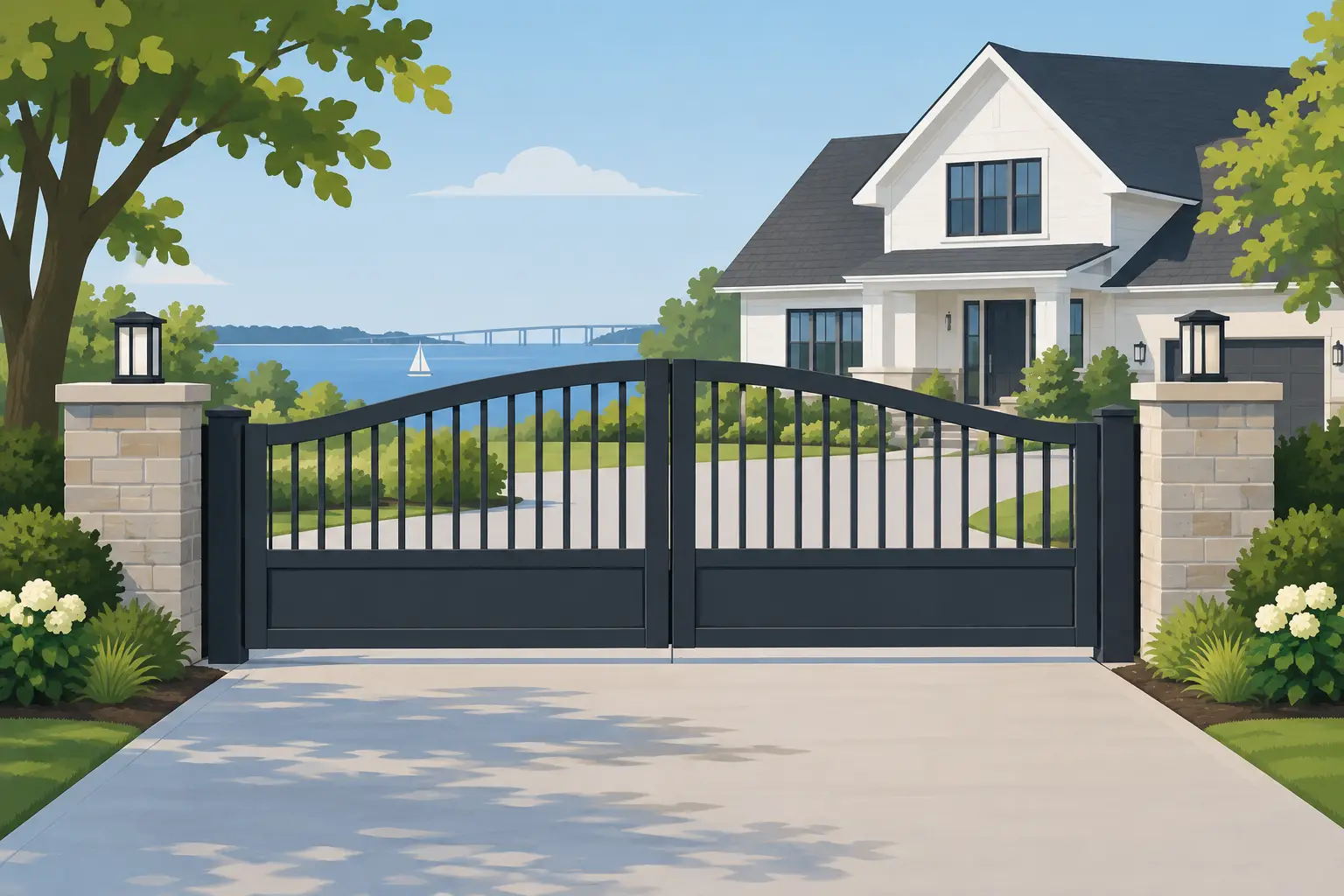
A driveway gate changes the first few seconds of arriving home. It can create a more private entrance, help keep children and pets within the property, add a visible layer of security, and give an established Maryland or DC home a finished, intentional look. This custom driveway gate guide is designed to help homeowners make choices that look right on day one and continue to work reliably through changing seasons.
The best gate is not simply the tallest or most decorative option. It needs to fit the driveway layout, daily traffic, landscape, fencing, local requirements, and the way your household actually comes and goes. A well-designed gate should feel like a convenience, not another item on the weekly to-do list.
Start With How Your Driveway Works
Before choosing a material or design, consider the approach to your driveway. Is the entrance level, sloped, narrow, curved, or close to a public street? Does the property have enough room for a gate to swing inward without blocking vehicles? These details determine whether a swing gate or sliding gate makes the most sense.
Swing gates remain a popular choice for residential properties because they offer a classic appearance and can be customized in single- or double-gate configurations. A single swing gate can work well for a smaller opening, while a double swing gate provides a balanced look across wider driveways. However, swing gates need clear space to operate. A steep upward slope, limited depth between the gate and garage, or an entrance that opens directly onto a busy road may make this option less practical.
Sliding gates are often a strong solution where a driveway slopes or where inward swing space is limited. They travel parallel to the fence line rather than into the driveway. That can make them especially useful for properties with a long, level run beside the entrance. The trade-off is that sliding systems require sufficient side clearance and careful planning for the track or cantilever system.
A professional site visit is valuable here. Measurements alone do not reveal drainage patterns, grade changes, turning radius needs, or the locations of utilities and existing hardscape. Planning the gate around those conditions protects the investment and avoids an installation that feels cramped or awkward.
Choosing a Custom Driveway Gate Style
Your gate should belong with the home, not look like an afterthought placed at the curb. The right style often takes cues from the architecture, existing fence, brick or stonework, outdoor lighting, and landscaping.
Traditional homes in Montgomery County and Northwest DC often pair naturally with ornamental metal gates featuring clean pickets, curved tops, or subtle decorative details. For a more contemporary home, a gate with horizontal lines, simple framing, and a darker finish can create a crisp, modern entrance. Estate-style properties may call for wider double gates, masonry columns, and custom details that make the approach feel more substantial.
Privacy is another design choice. An open ornamental gate preserves sightlines and creates an elegant front entrance, but it will not screen the property. A solid or semi-private design offers more separation from the street, though it may feel heavier visually and can be more affected by wind. Many homeowners choose a middle ground: a framed gate with partial visibility, strategically placed landscaping, and matching fencing that carries the design beyond the driveway.
Do not overlook proportion. A gate that is too short can appear insignificant next to tall columns or a large home. One that is too tall or overly ornate can overwhelm a modest frontage. An experienced contractor can help match the gate height, opening width, post size, and surrounding fence design so the finished entrance has the right scale.
Select Materials for Appearance and Long-Term Care
Material selection affects the gate’s appearance, durability, maintenance needs, and cost. In the Mid-Atlantic, gates must handle humid summers, rain, winter freezes, and occasional heavy snow. That makes quality fabrication and installation as important as the material itself.
Ornamental aluminum is a popular residential choice because it delivers the refined appearance of metal without the same risk of rust. It is lightweight, durable, and well suited for many automated systems. Aluminum gates can also complement ornamental aluminum fencing for a consistent look throughout the property.
Steel is exceptionally strong and can support a more substantial custom design, especially for wide openings or statement entrances. It does require a quality protective finish and ongoing attention to prevent corrosion if the coating becomes damaged. For homeowners who want a heavier, more traditional metal gate, steel can be an excellent choice when properly maintained.
Vinyl and composite materials can provide privacy and coordinate with certain fence styles. They are low-maintenance, but a driveway gate needs internal support and well-built hardware to prevent sagging or movement over time. Wood offers warmth and character, particularly alongside natural stone or traditional landscaping, but it requires regular sealing or staining and can expand or contract with moisture.
There is no universal best material. The right choice depends on whether your priorities are privacy, a custom architectural statement, minimal maintenance, or a close match to an existing fence. Quality posts, hinges, frames, and hardware should be part of the conversation from the beginning. A beautiful gate cannot perform properly on undersized supports.
Plan Access Before You Choose Automation
Automation can make a driveway gate dramatically more convenient, particularly for busy families, homes set back from the road, and properties where arriving after dark is common. But an operator should be selected for the gate’s weight, length, usage frequency, and configuration. It should not be treated as an accessory added at the end.
Common access options include vehicle remotes, keypads, telephone or app-based entry systems, and intercoms. A keypad works well for regular visitors, service providers, and older children, while an intercom or video entry system gives homeowners greater control over who enters. If the property has more than one household or frequent deliveries, it is worth discussing how guests will use the gate without creating daily inconvenience.
Safety matters just as much as access. Automated gates should include appropriate safety devices that detect obstructions and prevent the gate from closing on a vehicle, person, or pet. Proper placement of controls, warning signage, emergency release features, and operator components helps the system perform as intended. Gate automation is not an area to cut corners or rely on a one-size-fits-all setup.
Power also deserves early attention. Some sites are suited to a hardwired operator, while solar power can be useful where running electrical service would be disruptive or costly. Solar performance depends on exposure and daily use, so it should be evaluated based on the property rather than selected solely for convenience.
Account for Permits, Columns, and Existing Hardscape
A custom driveway gate often involves more than the gate itself. Depending on the property and jurisdiction, homeowners may need to consider permits, setback rules, homeowner association guidelines, utility locations, or requirements related to sight distance near the road. These questions are much easier to address before materials are ordered and installation begins.
The gate also needs a dependable foundation. Posts may be set in concrete, integrated with masonry columns, or engineered around existing structures. If your property includes a retaining wall, paver driveway, walkway, or stone entry feature, the gate design should account for those elements instead of forcing separate projects to compete with one another.
This is where a design-and-build contractor offers a practical advantage. Coordinating fencing, gate installation, columns, and hardscape work through one experienced team can create a cleaner result and reduce the frustration of managing multiple trades. A-1 Fencing helps homeowners throughout Maryland and the Washington, DC area plan exterior improvements with the same attention to workmanship, materials, and property care from start to finish.
Ask the Questions That Protect Your Investment
When comparing driveway gate proposals, look beyond the initial number. A lower price can leave out structural supports, safety equipment, electrical coordination, quality hardware, or site preparation that the project truly needs. Clear, upfront pricing should explain what is included and what conditions could affect the final scope.
Ask how the gate will be supported, what hardware and operator are recommended, how drainage and grade will be handled, and who will coordinate related work. If the gate is automated, ask about manual operation during a power outage, maintenance expectations, and service support if an issue develops. Homeowners should also confirm the warranty coverage for both materials and installation.
A reliable contractor will welcome these questions. They should inspect the site, explain available options in plain language, and make recommendations based on your property instead of pushing a standard gate onto every driveway.
Build an Entrance You Will Appreciate Every Day
A custom driveway gate should make your home feel more secure, more private, and more complete without complicating your routine. The strongest results come from thoughtful design, quality materials, properly sized components, and installation by a team that understands how the entire entrance works together.
Schedule a free in-home consult and estimate before committing to a design. Seeing the driveway in person is the best way to choose a gate that welcomes your family home and serves the property well for years to come.